
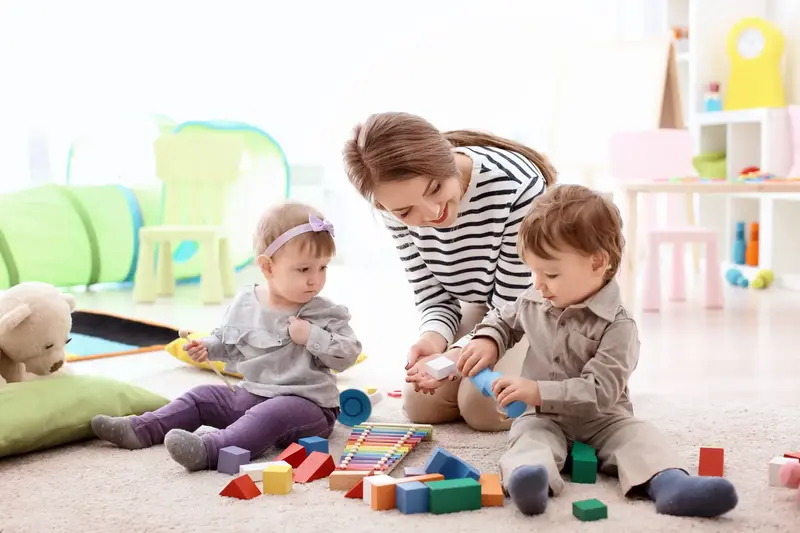
The months between 6 and 18 are full of firsts. Your baby may go from sitting with support to taking wobbly steps, and from babbling to saying their first words. This guide to baby milestones gives you an idea of what to look forward to, with one important reminder: every baby develops at their own pace.
Every baby develops at their own pace
Milestones are a helpful guide, not a test. Some babies crawl early and talk later, while others chat away before they’re on the move. A few skip crawling altogether. What matters most is that your baby keeps making progress over time. Try not to compare your baby too closely with siblings, cousins or babies at playgroup.
It can also help to think about development in a few broad areas: movement, communication, play and social skills, and early independence. Your baby may surge ahead in one area while another takes a little longer, and that’s perfectly normal. Babies who were born early may reach milestones a little later, based on their corrected age. If you’re ever unsure, your MCH nurse can help you understand where your baby is up to.
Baby milestones from 6 to 12 months
During this stage, many babies:
- Roll in both directions and begin to sit without support.
- Start to move around, whether by crawling, shuffling on their bottom or commando crawling.
- Pull up to stand while holding onto furniture.
- Pass toys from one hand to the other and begin to pick up small items with their thumb and finger.
- Babble with sounds like “ba-ba” and “da-da”, and respond to their name.
- Enjoy games like peekaboo and show they know familiar people.
- Become wary of strangers, which is a normal sign of strong attachment.

Baby milestones from 12 to 18 months
As your baby heads towards toddlerhood, you may notice them:
- Cruising along furniture, then taking first independent steps.
- Saying a few simple words and understanding much more than they can say.
- Pointing to show you things they’re interested in.
- Copying everyday actions, like brushing hair or talking on the phone.
- Stacking blocks, filling and emptying containers and exploring how things work.
- Trying to feed themselves with fingers or a spoon.
Simple ways to support your baby’s development
- Talk to your baby throughout the day, naming objects, actions and feelings.
- Read together every day. Board books with bright pictures are perfect at this age.
- Give plenty of floor time so your baby can practise rolling, crawling and pulling up.
- Sing songs and nursery rhymes, especially ones with actions.
- Offer safe, everyday objects to explore, like wooden spoons, cups and containers.
- Respond to your baby’s babbles and gestures as if you’re having a conversation.
- Spend time outdoors, letting your baby feel grass, watch leaves move and listen to birds.
- Keep screens to a minimum. The Australian 24-Hour Movement Guidelines recommend no screen time for children under 2.
Your MCH Key Ages and Stages checks
In Victoria, the free Maternal and Child Health (MCH) service offers Key Ages and Stages consultations, including checks at 8 months, 12 months and 18 months. Your MCH nurse will look at your baby’s growth and development and is a great person to talk to about any questions. If you’re ever concerned about your baby’s development, don’t wait for the next check. Contact your MCH nurse or GP. Raising Children Network also has reliable information on development at every age.
Celebrating milestones in our Nursery
In our Nursery, our educators notice and celebrate the small steps as well as the big ones. Our Reggio Emilia-inspired curriculum follows the Victorian Early Years Learning and Development Framework, so play is shaped around each baby’s interests and abilities. You’ll often hear about new achievements through daily updates in our parent app.
If you’d like to see how we support babies at our Keysborough centre, book a tour or call us on 03 9969 7057. We’d love to share in your baby’s next milestone.