
If your child has brought home a painting that is mostly one big brown swirl, you are not alone. For young children, the joy of art is often in the doing, not the finished result. Process art for preschoolers celebrates exactly that, and it offers far more learning than you might think.
What is process art?
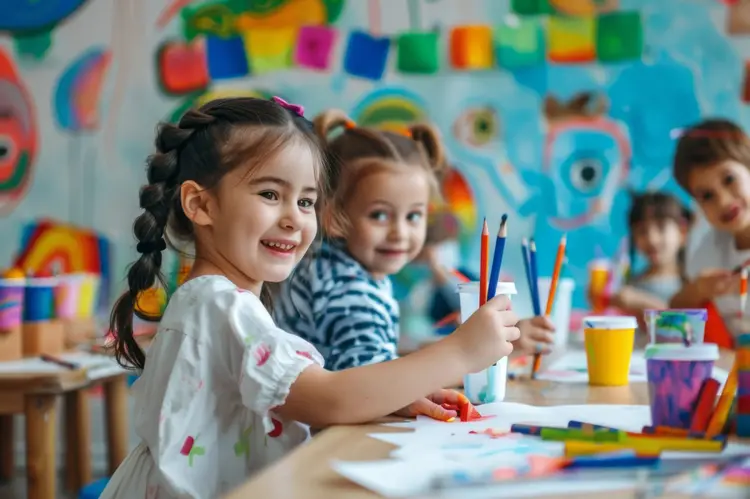
Process art focuses on the experience of creating rather than making something that looks a certain way. There is no sample to copy, no right or wrong answer and no set outcome. Children choose the materials, decide what to do and stop when they feel finished.
Compare this with a craft where every child glues the same eyes onto the same paper plate. That kind of activity has its place, but it leaves little room for children’s own ideas. In process art, ten children with the same materials will create ten completely different pieces.
It can help to remember that three year olds are often more interested in what paint does than in what it looks like at the end. Watching colours run together, feeling glue on their fingers and seeing a brush leave a trail are all discoveries in their own right.
Why the making matters more
When children are free to explore, they are learning in many ways at once:
- Creativity and imagination, as they come up with their own ideas.
- Problem solving, such as working out how to make paint stick or a collage stand up.
- Fine motor skills, from gripping brushes, squeezing glue and tearing paper.
- Language, as they describe colours, textures and what they are making.
- Confidence, because there is no way to get it wrong.
- Focus, as children become absorbed in what they are doing.
Process art also links closely with the Reggio Emilia idea that children have many ways of expressing themselves. Drawing, painting and sculpting are all languages children use to share what they think and feel.
Easy process art ideas to try at home
You don’t need a craft cupboard full of supplies. Start with a few basics and let your child lead:
- Paint with unusual tools such as sponges, forks, leaves, cotton buds or toy cars.
- Offer a collage tray with paper scraps, fabric, wool, bottle tops and glue.
- Draw with chalk on the driveway, then add water with a brush to see what happens.
- Make play dough together and add natural items like sticks, gumnuts or shells.
- Tape a big sheet of paper to the floor or a wall so your child can work large.
- Try mixing two colours and talk about what new colour appears.
Pop on an old shirt, cover the table and accept that some mess is part of the fun. Choose washable, non-toxic materials, and supervise closely with small items.
How to talk about your child’s art
Instead of asking “What is it?”, which can put children on the spot, try describing what you see. “You made lots of long lines” or “I can see you used the sponge to make dots” shows you are paying attention.
You could also ask “Can you tell me about your picture?” or “How did you make this part?” Let your child decide whether it is a picture of something or simply an exploration of colour. Both are wonderful.
Creative exploration at Nest
At Nest Early Learning in Keysborough, art is a big part of life in our Pre-Kindergarten room for children aged three to four. Our Reggio Emilia-inspired program gives children time and open-ended materials to explore their ideas, and our weekly incursions include arts and music at no extra cost. You can also follow along through daily updates in our parent app. We would love to show you around, so get in touch to book a tour or chat with our team.