

Tummy time is one of the simplest things you can do to support your baby’s development, but plenty of babies grumble about it at first. The good news is that a few easy tummy time ideas can turn it into a part of the day you both enjoy. Here’s why it matters and how to make it fun.
Why tummy time matters
When babies spend time on their tummies while awake, they strengthen the muscles in their neck, shoulders, arms and back. These are the same muscles they’ll later use to roll, sit, crawl and eventually pull up to stand. Tummy time also gives babies a different view of the world and helps reduce the chance of flat spots forming on the back of the head.
The Australian 24-Hour Movement Guidelines suggest that babies under one year have at least 30 minutes of tummy time spread across the day while they’re awake. That doesn’t need to happen all at once. Short, frequent sessions add up quickly.
Getting started from the early weeks
You can begin tummy time from the early weeks with just a minute or two at a time. Choose a moment when your baby is awake, alert and not too full, such as after a nappy change. Always stay with your baby during tummy time, and if they become sleepy, roll them onto their back to sleep, in line with safe sleep advice.
It’s normal for young babies to protest a little. Keep sessions short, stop before they become upset, and try again later. Over time, most babies build the strength to lift their heads and look around, and that’s when tummy time becomes much more interesting for them.
Simple, fun tummy time ideas
- Chest to chest: lie back on the couch or bed and place your baby on your chest. Your face is the best motivation for lifting their head.
- Get down to their level: lie on the floor facing your baby and chat, sing or pull silly faces.
- Use a mirror: a baby-safe mirror placed in front of them is endlessly fascinating.
- Try a rolled towel: a small rolled towel under the chest and armpits can give a little extra support while you supervise.
- Offer interesting things to look at: high-contrast cards, soft books or a favourite toy just within reach encourage reaching and lifting.
- Tummy time over your lap: lay your baby across your knees and gently pat their back.
- Make it part of the routine: a few minutes after each nappy change or bath means it happens without much planning.
- Change the scenery: a clean rug in a different room, or a blanket on the grass in the shade, keeps things fresh.
When to check in with a professional
Every baby develops at their own pace, and some take longer to warm up to tummy time than others. If your baby seems to strongly prefer turning their head to one side, has trouble lifting their head as they get older, or you have any concerns about flat spots, have a chat with your Maternal and Child Health (MCH) nurse or GP. Raising Children Network also has helpful, practical information on tummy time and early movement.
Tummy time in our Nursery
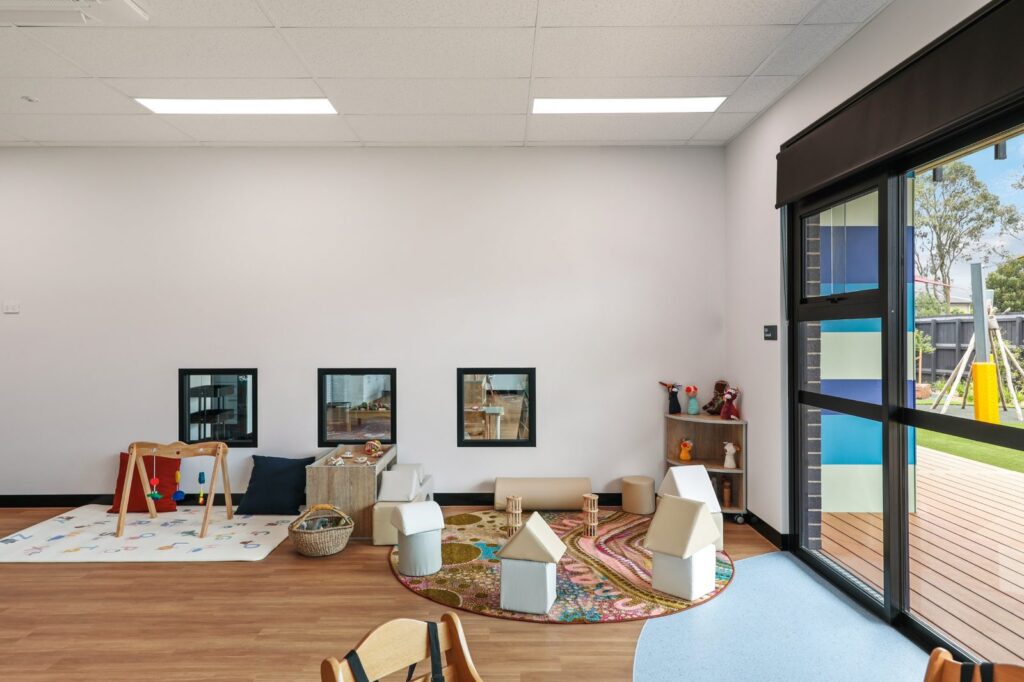
In our Nursery, floor play is a big part of every day. Our educators set up soft, safe spaces where babies can spend time on their tummies, explore toys and textures, and practise new movements at their own pace, always with an educator close by. Our play-based program follows the Victorian Early Years Learning and Development Framework, so movement and discovery go hand in hand.
If you’d like to see how we support babies’ early development, we’d love to show you around our Keysborough centre. Book a tour or give the team a call on 03 9969 7057. You might even pick up a few new tummy time ideas to try at home.


